Why ground conditions are the starting point for any screw piling assessment
As with every foundation method, the suitability of screw piling for a specific project begins with the ground. The soil type, its strength and density, the presence of obstructions, and the groundwater conditions all determine whether a helical pile can advance consistently to the required depth, develop the required capacity, and produce a reliable torque to capacity relationship that can be used to verify performance during installation. Getting this assessment right before any design work begins is what separates a screw piling project that runs smoothly from one that encounters problems on site that should have been identified and addressed at the design stage.
The ground conditions where screw piling performs reliably
Screw piling performs best in cohesive soils such as firm to stiff clays and in medium dense granular soils where the helical plates can advance consistently and develop reliable bearing resistance against the surrounding soil. London Clay, which is the dominant soil type across much of the south east, is one of the most suitable ground conditions for screw piling. The clay provides consistent resistance to the helical plates as the pile advances, the torque to capacity relationship is well established and reliable in these conditions, and the pile develops good capacity at relatively modest depths.
Medium dense sands and gravels are also suitable for screw piling provided the density is sufficient to generate the required torque at the design depth. In these conditions the helical plates bear against the granular soil particles and develop capacity through a combination of plate bearing and shaft friction, and the installation process is typically smooth and consistent provided no significant obstructions are present.
How the ground conditions affect the screw piling installation process
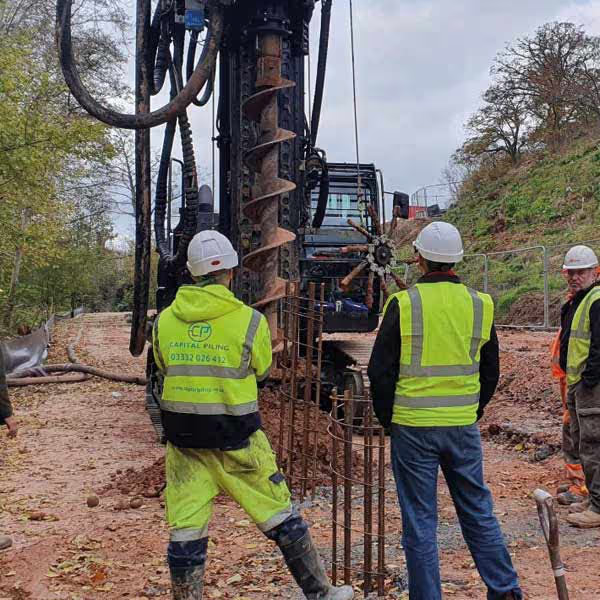
As the pile rotates into the ground the helical plates cut through the soil and bear against it, generating the torque resistance that the installation monitoring system records throughout the process. In cohesive soils the resistance builds steadily and consistently with depth as the undrained shear strength of the clay increases, producing a smooth and predictable torque profile that gives the installation team confidence that the pile is performing as expected at every stage of the process.
In granular soils the torque profile is more variable, reflecting the natural variation in density and particle size that granular deposits typically exhibit. Where the ground investigation has characterised the granular profile well, the expected torque profile can be predicted with reasonable accuracy and significant deviations from it during installation can be identified and investigated promptly. Where the investigation is less detailed, more variability in the installation data should be anticipated and factored into the programme and quality management process.
On sites subject to Tree Preservation Orders or environmental constraints, the ground conditions within the root protection area need to be assessed specifically. The installation process must not cause unacceptable disturbance to the soil structure within the root protection zone, and in some cases the installation methodology may need to be adapted to meet the requirements of the arboriculture consultant or planning authority. We work through these requirements as part of the pre-construction design process on TPO restricted projects, making sure the installation approach is compliant before work begins.
The soil types and site conditions where screw piling is most regularly specified on ground condition grounds
Screw piling is most regularly specified on ground condition grounds on sites underlain by London Clay and similar cohesive deposits across the south east, where the ground conditions are well suited to the method and the torque to capacity relationship is reliable and well documented. It is also used on sites with medium dense granular soils where the density profile identified in the ground investigation confirms that adequate torque can be developed at the design depth.
On brownfield sites with made ground of variable composition, screw piling can be effective where the investigation has characterised the made ground sufficiently and confirmed that no significant obstructions are present within the pile depth. Where the made ground composition is uncertain or where obstructions are likely, a more detailed investigation or exploratory installation trials may be needed before the method is confirmed.
How ground conditions influence the screw pile specification and torque criteria
The ground conditions identified in the ground investigation directly determine the pile shaft diameter, the helix configuration, the design depth, and the minimum installation torque for each pile position. Using shaft diameters of 60mm, 76mm, and 89mm with helix plates sized and spaced to suit the specific soil profile, we develop a pile specification that is optimised for the ground conditions on site rather than selected from a standard catalogue.
The torque to capacity relationship is derived using the soil parameters from the ground investigation and the specific pile geometry, and it is this relationship that allows installation torque to be used as a reliable in-process capacity verification method. In cohesive soils with well defined shear strength profiles the relationship is well established and the torque criteria can be derived with confidence. In more variable or uncertain ground conditions a more conservative approach to the torque criteria may be adopted, or load testing may be specified to verify the relationship before it is relied upon across the full pile group.
Ground conditions where screw piling is not suitable and what to do if you are unsure
Screw piling is not suitable in very hard ground, rock, or heavily cemented layers where the helical plates cannot advance without damage to the pile or the installation equipment. Significant buried obstructions including old foundations, dense brickwork, large boulders, and steel from previous structures can cause installation refusal before the required depth is reached, and unlike some bored methods there is no mechanism to break through or bypass these obstructions during the rotational installation process.
Very soft or loose soils present a different challenge. Where the ground is too weak to generate adequate torque at the required depth, the torque to capacity relationship becomes unreliable and the pile may not develop the capacity the design requires even if the installation appears to proceed normally. In these conditions additional load testing is needed to verify performance, or an alternative foundation method may be more appropriate.
A ground investigation is always the right starting point for confirming suitability. If you have investigation data and are unsure whether your ground conditions are suitable for screw piling, we are happy to review it and advise. For clients who have not yet commissioned an investigation, our in house team can advise on the scope and specification of the investigation needed for your site before any design work begins.