Where screw piling is used and why it is specified across such a broad range of projects
Screw piling is one of the more versatile foundation methods available, and its range of applications is broader than many people expect. It is not a niche solution for unusual situations. It is a practical, structurally reliable foundation method that is regularly specified across residential, commercial, and infrastructure projects where the ground conditions are suitable and the characteristics of the method offer genuine advantages over bored or driven alternatives. Understanding the typical applications helps project teams identify early whether screw piling is likely to be relevant to their project and what it can deliver in the contexts where it performs best.
The project types and situations where screw piling is most frequently specified
Screw piling is regularly specified on new build residential schemes, residential and commercial extensions, portal frame commercial buildings, modular and volumetric construction projects, infrastructure works, and temporary structures. It is also frequently required on sites subject to Tree Preservation Orders, protected land designations, or council environmental requirements where ground disturbance must be minimised and a concrete free installation method is either preferred or mandated by the planning authority or arboriculture consultant.
The method is particularly well suited to constrained access sites where compact installation equipment is needed, to projects where programme efficiency is a priority, and to urban and suburban environments where noise and vibration must be kept to a minimum. These characteristics mean screw piling often appears on projects where other methods have been ruled out by site constraints rather than by structural or ground condition limitations.
How screw piling is applied across different project types
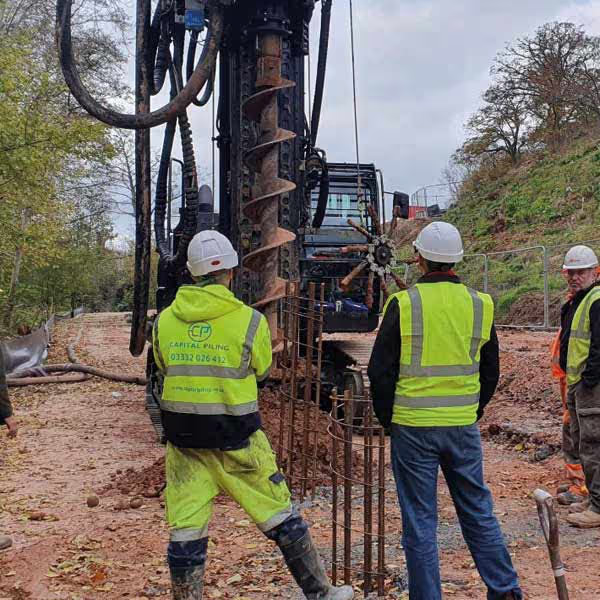
The application of screw piling follows the same fundamental process regardless of the project type. The pile is rotated into the ground to the required depth and torque, pile caps or brackets are fixed to the pile heads, and the connecting structure above, whether ground beams, an RC slab, or a steel frame, is formed to complete the foundation. What changes across different applications is the pile specification, the layout, the connecting structure design, and the specific site constraints that need to be managed during installation.
On a residential extension the piles are typically arranged in a simple layout beneath the load bearing walls, connected by reinforced concrete ground beams that tie the pile heads together and support the new structure above. On a commercial portal frame building the piles are positioned at the column bases, with the portal frame structure connecting directly to the pile caps or brackets above. On a TPO restricted site the pile positions and installation methodology are developed in conjunction with the arboriculture consultant to ensure the root protection area requirements are met throughout the installation process.
The specific contexts where screw piling is most commonly encountered
Residential construction is one of the most common contexts for screw piling. New build houses, extensions, and residential developments on sites with suitable ground conditions and access constraints or programme pressures that favour the method are all projects where we regularly install screw piles. The speed of installation and the absence of a concrete curing period are particularly valuable on residential projects where the client is living on or adjacent to the site and wants the foundation completed as quickly and cleanly as possible.
Commercial and light industrial construction is another significant application area. Portal frame buildings, warehouse structures, and modular commercial developments benefit from the same speed and simplicity advantages as residential projects, with the added benefit that the steel to steel connection between the pile and the structural frame above is often more straightforward and faster to form than a concrete ground beam connection would be.
On sites with TPO protected trees, protected land, or council imposed environmental requirements, screw piling is frequently the method that makes a project possible at all. Where other foundation methods would require excavation within root protection areas or ground disturbance that the planning authority or arboriculture consultant will not permit, screw piling installed with compact equipment and without concrete or excavation provides a compliant and structurally reliable solution. We have extensive experience of working within these constraints and of producing the documentation required to demonstrate compliance with TPO and environmental requirements to the relevant authorities.
How pile specifications vary across different application types
The pile specification for any screw piling application is determined by the structural loads, the ground conditions, and the specific requirements of the project. Using shaft diameters of 60mm, 76mm, and 89mm with helix configurations tailored to the ground conditions, we can achieve the capacities required for a broad range of residential and commercial applications. The number of helical plates, their diameter, and their spacing along the shaft are all adjusted to optimise the pile performance in the specific ground profile identified by the ground investigation.
For applications involving lateral loading, such as piles supporting retaining structures, noise barriers, or signage, the pile specification needs to account for bending moments as well as axial loads, and the design process involves a more detailed assessment of the pile's response to lateral forces in the specific ground conditions. We work closely with structural engineers on these applications to ensure the pile specification is right for the full range of forces involved, and for clients without a structural engineer our in house design team can manage the full structural assessment and pile design from the outset.
What to consider when assessing whether screw piling is appropriate for a specific application
Screw piling is the right choice for an application when the ground conditions support reliable helical installation, the structural loads are within the achievable capacity range, and the site constraints and programme requirements are compatible with the method. It is not the right choice simply because it is fast or because it avoids concrete, and it should always be assessed against the specific requirements of the project rather than assumed to be appropriate without proper evaluation.
On applications involving TPO restrictions or protected land requirements, the compliance requirements of the planning authority or arboriculture consultant need to be understood and factored into the foundation design from the very beginning. Getting those requirements confirmed in writing before the foundation design is finalised avoids the risk of a design that is technically sound but does not satisfy the planning conditions, which is a problem that is significantly easier to prevent than to resolve once the design has been committed to. If you are unsure whether screw piling is the right approach for your specific application, we are happy to review the available information and give you a clear recommendation based on what the project actually requires.