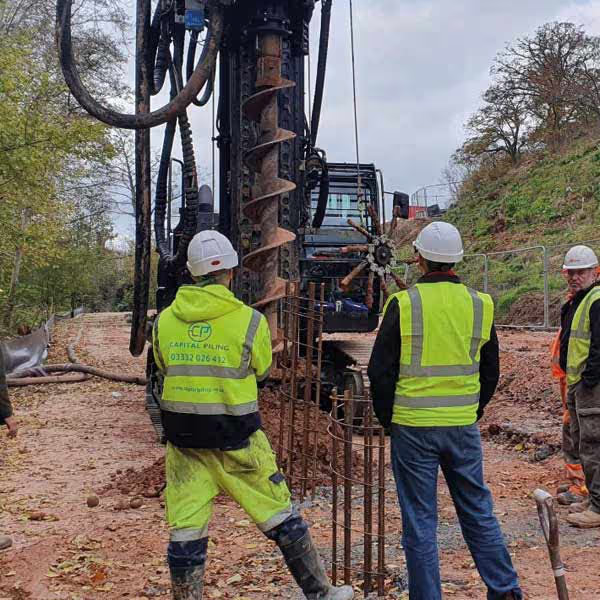
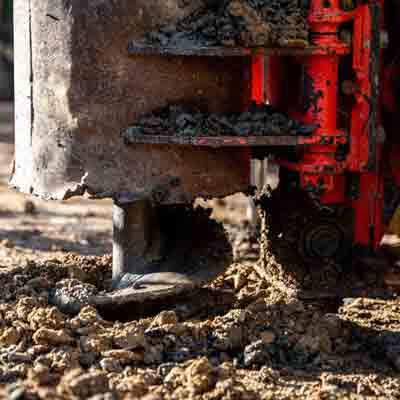
SFA open bore piling is a foundation method used to transfer structural loads into the ground by forming reinforced concrete piles within a drilled borehole. The system uses a sectional flight auger to remove soil and create the bore, which is then filled with concrete and reinforcement to form a stable, load-bearing element.
It is commonly used on projects where ground conditions allow for open bore construction and where controlling noise, vibration and overall site impact is important. Because the process relies on drilling rather than impact, it offers a more controlled and predictable installation compared to driven piling methods.
This makes it particularly suitable for use in built-up environments or on sites where protecting surrounding structures is a key consideration.
Key Characteristics
SFA open bore piling is defined by its balance between performance and practicality. It allows engineers to install structural foundations efficiently while maintaining a high level of control over the process.
The system uses sectional equipment, which means it can be adapted to suit restricted access conditions without compromising on structural integrity. At the same time, it delivers reliable load-bearing performance through the use of reinforced concrete piles designed to meet project-specific requirements.
Another important characteristic is the relatively low level of noise and vibration generated during installation, which makes it a preferred option in residential areas or sites where disruption needs to be minimised.
Installation Process
The installation process begins with a sectional auger drilling into the ground to the required depth. As the auger advances, it removes soil and forms a borehole that will become the pile.
Once the design depth is achieved, the bore is prepared for construction. A steel reinforcement cage is then installed into the bore, followed by the placement of concrete. This creates a reinforced concrete pile that transfers structural loads into deeper, more stable ground layers.
Each stage of the process is carefully controlled to ensure the bore remains stable and that the finished pile meets the required structural performance.
Typical Applications
SFA open bore piling is widely used across a range of construction projects where a dependable and adaptable foundation solution is required.
It is particularly common in residential developments, extensions and low-rise commercial buildings, where site conditions often demand a method that can work within limited space. It is also frequently used in urban environments, where reducing vibration and protecting nearby structures is a priority.
The method performs best in stable ground conditions such as clay or dense sand, where the bore can remain open during installation without the need for additional support.
Design and Ground Considerations
The design of SFA open bore piles is based on a combination of structural requirements and ground conditions. Factors such as load capacity, soil strength and pile spacing are all taken into account to ensure the foundation performs as intended.
Pile diameters and depths can vary depending on the project, with larger piles providing increased load capacity where required. Reinforcement design is also tailored to suit the structural demands placed on each pile.
A thorough ground investigation is typically carried out before installation to confirm that the chosen method is appropriate and to inform the overall design.
Limitations and Suitability
While SFA open bore piling is a highly effective solution in many situations, it is not suitable for every ground condition. The method relies on the stability of the bore during installation, which means it may not perform as well in loose or water-bearing soils without additional support measures.
On sites where ground conditions are highly variable or where very high structural loads are involved, alternative piling methods may provide a more appropriate solution.
As with all foundation systems, selecting the right approach depends on a clear understanding of the site conditions and the specific requirements of the project.