Situations That Demand Mini Piling
Mini piling steps in where traditional shallow foundations cannot. Common reasons include ground conditions, access limitations, or other site constraints. Mini piles transfer loads deeper into the ground. This gives a stable foundation where surface soils cannot support the structure.
It is often used across residential and commercial projects. The method is particularly common in urban environments. Here, both ground conditions and access are often restrictive.
Unstable or Weak Ground Conditions
Mini piling is often used where the surface ground lacks bearing capacity. This includes soft clays, loose soils, and made ground. Each of these can cause settlement under traditional foundations.
Mini piles reach deeper, more stable strata. They transfer loads to stable ground and reduce the risk of long-term movement.
Restricted Access and Limited Working Space
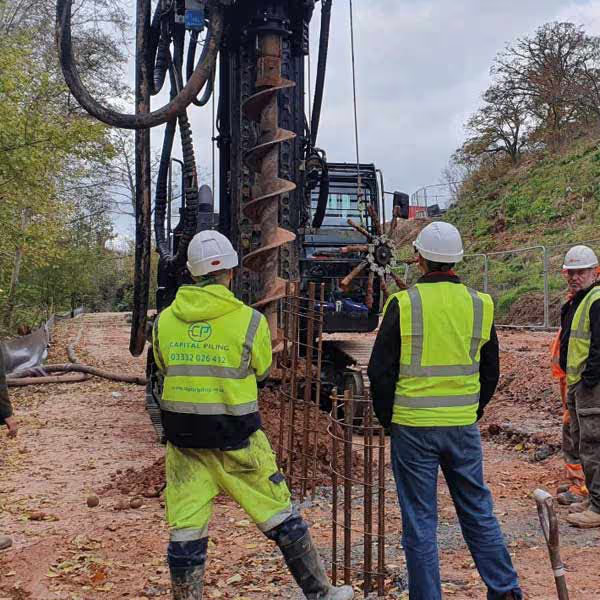
Mini piling is often selected on limited access sites or constrained spaces. It reaches sites accessed only through narrow passages, rear gardens, or interiors.
Compact rigs let contractors work in locations where larger equipment cannot. This makes it a practical solution for built-up areas and infill sites.
Working Next to Existing Structures
Foundations close to existing buildings call for a controlled, low-impact method. Mini piling suits these situations. It produces less vibration and installs with more precision than other methods.
This is particularly relevant for extensions, structural alterations, and underpinning. Here, new foundations must integrate with existing structures without causing movement or damage.
Variable or Uncertain Ground Conditions
On many sites, ground conditions can change a lot across short distances. This makes traditional foundation design difficult. After all, bearing capacity may vary across the footprint of the structure.
Mini piling adapts to different foundation depths and designs. This way, it can suit local ground conditions. Such provides consistent support across the entire building.
Basement Construction and Underpinning Works
Mini piling is often used in basement construction and underpinning. Some projects need foundations beneath or within an existing structure. Underpinning is one common example. In these cases, mini piles support the building. Meanwhile, excavation or structural changes can take place.
Mini piling can install piles in confined spaces with minimal disturbance. This makes it the right choice for this type of work.
Minimising Noise, Vibration, and Disruption
Sites close to neighbouring properties often need careful control of noise and vibration. Mini piling is much quieter than traditional driven piling. It also produces far less vibration.
Mini piling suits residential environments and projects where keeping disturbance low is important.
Urban and Constrained Site Conditions
Mini piling is often used in cities and built-up areas. Here, construction must take place within tight boundaries. Limited access, existing structures, and complex ground conditions often rule out traditional methods.
In these situations, mini piling provides a flexible and efficient solution. This allows construction to proceed without major alterations to the site.
A Practical Solution for Challenging Sites
Mini piling suits sites where conditions prevent the use of conventional foundations. It handles poor ground, restricted access, or existing structures. The method delivers stable foundations without large-scale excavation or heavy equipment.
Mini piling's adaptability makes it suitable for a wide range of projects. Its use cases span from small residential works through to complex structural developments.
Do You Need More Information?
Do you need further guidance on whether mini piling is suitable for your project? If so, a specialist contractor such as Capital Piling can review your site conditions. We're here to recommend the most appropriate solution.