Understanding when screw piling is the right structural foundation choice
Screw piling is not a universal solution and it is not specified simply because it is fast or because it avoids concrete. It is chosen when a proper assessment of the ground conditions, the structural loads, the site constraints, and the programme requirements all point towards it as the most appropriate and practical foundation method for the specific project. One of the most distinctive aspects of screw piling is the range of situations it can unlock that other foundation methods cannot, from sites with Tree Preservation Orders where ground disturbance must be minimised, to protected land and environmentally sensitive locations where a concrete free, low excavation approach is a planning requirement rather than just a preference.
The conditions and circumstances that most commonly lead to screw piling being specified
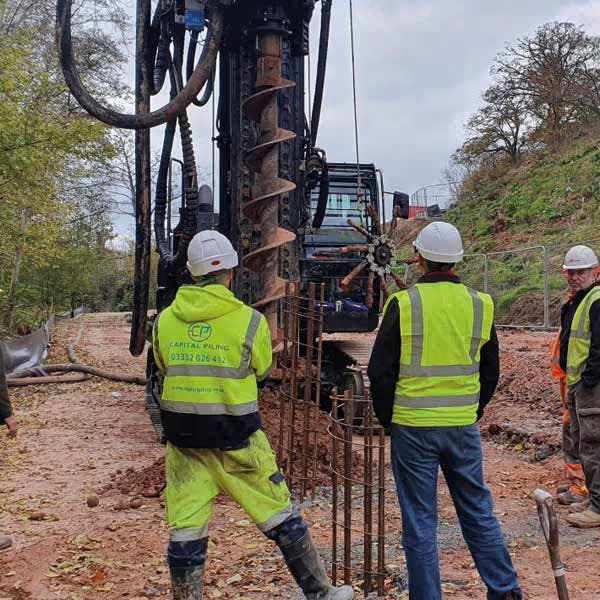
Screw piling is most commonly specified when the ground conditions are suitable for helical installation, the structural loads are within the range achievable with the method, and the advantages of a concrete free, low vibration, fast installation are genuinely valuable for the project. It is regularly chosen on sites where access is restricted and compact equipment is needed, on projects where programme pressure makes the absence of a concrete curing period a significant benefit, and in urban and residential environments where minimising noise and disruption is a priority.
It is also a method that is frequently required rather than simply preferred. On sites subject to Tree Preservation Orders, local planning authorities and arboriculture consultants will often specify that foundations must not disturb the root protection areas of protected trees. Screw piling, because it installs by rotation without excavation and without the need for concrete, is one of the very few foundation methods that can satisfy these requirements and allow construction to proceed in locations that would otherwise be inaccessible. Similarly on protected land, sites with environmental designations, or projects where council requirements restrict ground disturbance, screw piling is often the only practical structural foundation solution available.
How the decision to use screw piling is reached
The decision to specify screw piling begins with a review of the ground investigation data and the structural loads. The geotechnical information tells the structural engineer whether the ground conditions are suitable for helical installation and what torque criteria and pile geometry are likely to achieve the required capacity. The structural loads confirm whether those requirements are within the range the method can deliver in the specific ground conditions on site.
Where the project is also subject to TPO restrictions, environmental designations, or council requirements around ground disturbance, the constraints imposed by those requirements are assessed alongside the technical and structural considerations. In many cases it is these planning and environmental requirements that drive the decision to use screw piling, with the structural and ground condition assessment then confirming that the method is technically viable for the specific project. We work through this full assessment with structural engineers and planning consultants at the pre-construction stage, and for clients who do not yet have a structural engineer in place our in house design team can carry out the full assessment and produce the pile specification and foundation design from the outset.
The project types and site conditions where screw piling is most regularly encountered
Screw piling is regularly used on new build residential projects, residential and commercial extensions, portal frame commercial buildings, modular and volumetric construction schemes, and infrastructure projects. It is particularly prevalent on urban and suburban sites where restricted access, programme pressure, and the need to minimise disruption all point towards a method that is compact, quiet, and fast.
On sites with TPO protected trees, screw piling is frequently the only foundation method that satisfies the root protection area requirements set by the local planning authority or the project arboriculture consultant. On protected land, sites with ecological or environmental designations, and projects where the council has imposed specific requirements around excavation or ground disturbance, screw piling offers a compliant and practical solution that other methods cannot match. We install screw piles across residential and commercial projects throughout London and the south east and have experience of working within the specific constraints that TPO and protected land requirements impose on the foundation design and installation process.
Screw piling is confirmed as technically appropriate when the ground investigation data supports reliable helical installation to the required depth and torque in the specific soil profile on site, and when the structural loads at each pile position are within the capacity achievable with the pile geometry available. Using shaft diameters of 60mm, 76mm, and 89mm with helix configurations tailored to the ground conditions, we can achieve the load capacities required for a broad range of residential and commercial structural applications.
Where TPO or environmental constraints apply, the pile positions and installation methodology also need to demonstrate compliance with the root protection area requirements or environmental conditions set by the planning authority. This may influence the pile layout, the equipment used, and the working methods adopted during installation, and these requirements need to be confirmed and documented before work begins rather than addressed reactively on site.
What to think about when assessing whether screw piling is appropriate for your project
Screw piling is the right choice when the evidence supports it. That evidence comes from a ground investigation, a structural load assessment, and a realistic evaluation of the site constraints and any planning or environmental requirements that apply. Where TPO restrictions or protected land designations are involved, the requirements of the local planning authority and the project arboriculture consultant need to be understood and factored into the foundation design before any method is confirmed, and screw piling should be assessed against those requirements explicitly rather than assumed to comply without verification.
Where screw piling is being considered alongside other methods, the comparison should be made on the basis of structural suitability, programme impact, cost, planning compliance, and site constraints taken together. If you are at the early stages of a project and are unsure whether screw piling is the right approach, whether because of ground conditions, structural requirements, or planning constraints including TPO or protected land requirements, we are happy to review the available information and give you a clear and honest assessment of whether the method is suitable for your specific situation.