Why restricted site conditions are one of the most common reasons screw piling is specified and what restricted access actually means in practice
Restricted access is one of the most frequently cited reasons for specifying screw piling, but the term covers a wide range of site conditions that each present different practical challenges for a foundation contractor. A restricted site might mean a rear garden extension accessible only through a narrow side passage, an inner city commercial plot surrounded by existing buildings with no room to manoeuvre a large rig, a basement or undercroft with limited headroom, or a site where overhead power lines, underground services, or party wall constraints limit where equipment can operate and how it must be positioned during the works.
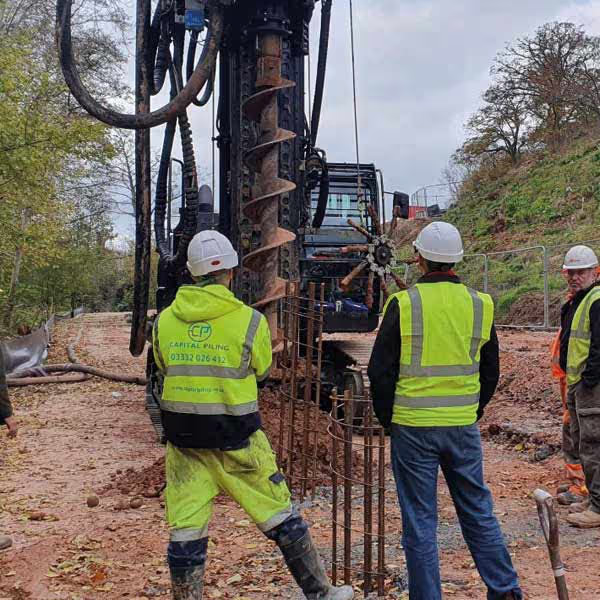
What these situations have in common is that the equipment used to install the foundation must be smaller, more manoeuvrable, and more adaptable than what would be used on an open site with unrestricted access. Screw piling is well suited to these conditions because the installation equipment can be configured to match the specific constraints of the site, with compact tracked rigs capable of passing through gaps as narrow as 750mm, low headroom attachments for basement and undercroft work, and remote hydraulic power packs that allow the drive head to operate at a distance from the power source where space around the pile positions is extremely limited.
The access constraints that screw piling can accommodate and the equipment configurations that make it possible
The minimum access width required for screw piling equipment depends on the size of the rig being used, which in turn depends on the pile specification and the torque required to install it. For lightly loaded residential piles in soft to firm ground, compact mini excavators with a track width of 750mm to 850mm and a hydraulic rotary head attachment are frequently sufficient, and these machines can pass through a standard garden gate or side passage with minimal modification to the access route. For more heavily loaded piles requiring higher installation torques, a larger machine may be necessary, but purpose built compact piling rigs are available in configurations that can work in considerably tighter spaces than a standard CFA or bored pile rig of equivalent torque output.
Low headroom is a constraint that screw piling can accommodate more readily than most other pile types. Standard bored and CFA piling rigs require several metres of clearance above the pile position to accommodate the Kelly bar or auger string. Screw piles are installed in short extension sections typically 1.5m to 3m in length, and the installation equipment only needs headroom sufficient to handle one section at a time. In basement and undercroft situations with headroom as low as 2.5m, screw piling with short extension sections is often the only structural foundation method that can physically operate within the space available.
How the installation methodology is adapted to work within the specific constraints of a restricted site
Working on a restricted site begins with a thorough pre-construction assessment of the access conditions and the constraints that will affect the installation. This covers the width and height of the access route to the working area, the ground bearing capacity of any surfaces the equipment must cross to reach the pile positions, the proximity of existing structures and boundaries to the pile layout, the presence of underground services or buried obstructions within the working area, and any overhead constraints including power lines, roof overhangs, or tree canopies that affect the operating envelope of the equipment.
From that assessment the installation methodology is developed to suit the specific constraints identified. Equipment is selected or configured to match the access width and headroom available, the installation sequence is planned to minimise rig movements within the restricted working area, and the pile extension section lengths are chosen to suit the headroom at each pile position. Where the access route passes over existing hard surfaces or structures, temporary protection or spreader plates are used to distribute the equipment loads and prevent damage.
Capital Piling carries out pre-construction site assessments as a standard part of project preparation on all restricted access projects, and the methodology developed from that assessment is documented and agreed with the client or main contractor before mobilisation. This ensures that the constraints have been properly understood and planned for rather than discovered on the day the equipment arrives on site.
The project types and site configurations where restricted access working is most commonly required
Restricted access working is most common on residential extension and new build projects in urban and suburban settings, where the working area is a rear garden or side return accessible only through the existing property or via a narrow passage between buildings. On these projects the foundation works must be completed using equipment that can reach the pile positions without causing damage to the existing building, the boundary structures, or the access route, and without requiring access that the site simply cannot provide.
Basement construction projects in existing buildings present a particular set of restricted access challenges, combining low headroom with confined working space and the need to avoid damaging the existing structure during the foundation works. Screw piling in these situations typically uses short extension sections and a compact rotary drive head mounted on a mini excavator that has been modified or purpose built for low headroom operation, with the hydraulic power supply routed from a power pack located in a less restricted area of the site.
Inner city commercial projects on tight urban plots, projects within existing buildings such as industrial units or warehouses requiring additional foundation support, and infrastructure projects in confined spaces such as railway embankments or bridge abutments are all situations where the access constraints favour screw piling over methods that require larger equipment or more working space around each pile position.
Equipment specifications, minimum access dimensions, and the technical parameters that define what is achievable on a restricted site
The compact mini excavators used for residential and light commercial screw piling typically have a machine width of 750mm to 1000mm in their narrowest tracked configuration, a working weight of 1.5 to 3.5 tonnes, and a hydraulic output sufficient to generate installation torques of 8 to 20 kilonewton metres at the rotary head. These torque outputs are adequate for the pile geometries used on the majority of residential and light commercial projects in typical UK ground conditions, and the machine dimensions allow access through standard domestic gates and side passages with minimal preparation of the access route.
For projects requiring higher installation torques, purpose built compact piling rigs are available with torque outputs of 30 to 60 kilonewton metres or more in machine configurations that are significantly smaller than a standard CFA or bored pile rig of equivalent capacity. These machines are designed specifically for restricted access working and combine the torque output needed for commercial pile specifications with the compact dimensions and manoeuvrability required for tight urban sites.
Low headroom attachments for screw pile installation are typically designed to operate with a minimum clearance of 2.2m to 2.5m above the pile position, using short extension sections of 1.0m to 1.5m in length to advance the pile incrementally to the required depth. The connection between extension sections is a mechanical coupling that can be made and broken quickly within the available headroom, keeping the installation cycle time per section short and the overall programme efficient despite the constraints.
What needs to be assessed before committing to screw piling on a restricted site and what can go wrong if the constraints are not properly understood in advance
The most important thing to establish before committing to screw piling on a restricted site is whether the equipment required to install the specified piles can physically access all pile positions within the constraints that exist. This sounds straightforward but it requires a detailed and honest assessment of the access route, the working area, and the pile specification together. A machine that can pass through the access gate may not be able to generate the torque required to install piles of the specified geometry in the ground conditions on site, and a machine with sufficient torque output may not fit through the access available. These constraints need to be resolved at the design stage, not on the day the equipment arrives.
Underground services within the working area are a particular concern on restricted sites where there is limited room to adjust pile positions away from service locations without compromising the structural layout. Services should be located, marked, and assessed against the pile layout before installation begins, and any conflicts between pile positions and service locations should be resolved through a formal design review rather than an on-site decision to move the pile without structural input.
Capital Piling has extensive experience of working on restricted access sites across London and the south east, including rear garden extensions, basement projects, inner city commercial plots, and infrastructure works in confined spaces. We carry out pre-construction site assessments on all restricted access projects, select equipment matched to the specific access and torque requirements of each project, and develop installation methodologies that reflect the actual constraints on site rather than assuming the site will accommodate a standard approach.